
Smart Material Alternatives to Reduce Construction Cost in 2026
Looking to reduce construction costs without compromising quality? Discover smart material alternatives like AAC blocks, M-Sand, prefab elements, and more for modern construction projects in 2026.
2/19/20262 min read
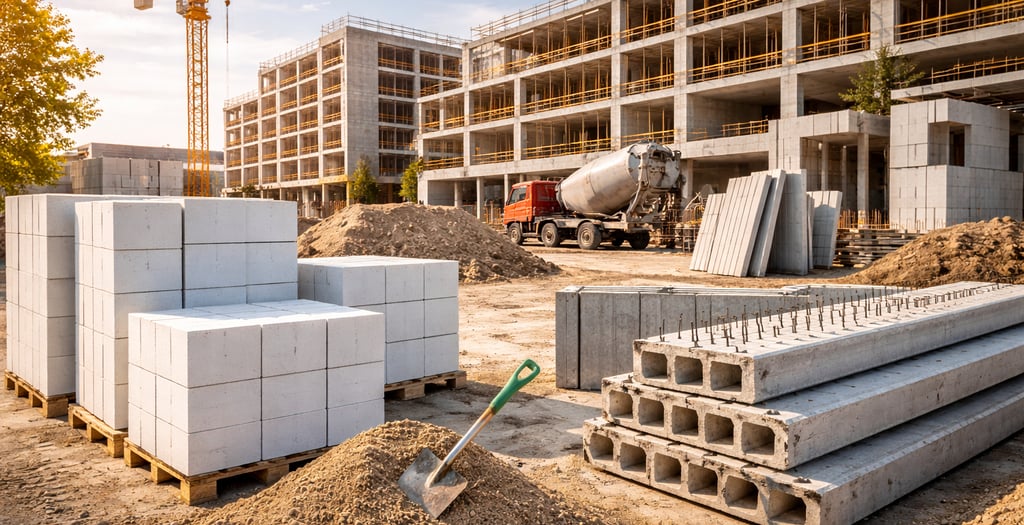
Smart Material Alternatives – The Future of Cost-Effective Construction
A few years ago, reducing construction cost meant one thing — compromise.
Compromise on material quality.
Compromise on finishing.
Compromise on durability.
But 2026 construction doesn’t work that way.
Today, smart contractors are not reducing cost by lowering quality — they are reducing cost by choosing smarter materials.
Rising cement prices, fluctuating steel rates, and increasing labor charges have forced the construction industry to rethink traditional methods.
The real question is no longer:
“How do we spend less?”
It is:
“How do we build smarter?”
Let’s look at practical material alternatives that are helping contractors stay competitive.
1. AAC Blocks Instead of Traditional Red Bricks
Traditional clay bricks have been used for decades. But they are heavy, consume more mortar, and increase structural load.
AAC (Autoclaved Aerated Concrete) blocks are:
• Lightweight
• Thermally efficient
• Faster to install
• Reduce dead load on structure
Because AAC blocks are larger in size, labor productivity increases and mortar consumption reduces.
Result?
Lower structural steel requirement + faster completion = overall cost saving.
For G+2 or commercial buildings, this becomes highly beneficial.
2. M-Sand Instead of River Sand
River sand availability is becoming unpredictable and expensive.
M-Sand (Manufactured Sand) is:
• Factory produced
• Consistent in quality
• Environmentally friendly
• Often more affordable
When properly graded, M-Sand performs equally well for plastering and concrete.
Many modern projects now completely rely on M-Sand to avoid supply delays.
3. Ready-Mix Concrete (RMC) Instead of Site Mixing
Manual concrete mixing leads to:
• Inconsistent quality
• Higher material wastage
• More labor dependency
RMC offers:
• Controlled mix design
• Faster execution
• Reduced wastage
• Better structural strength consistency
For larger projects, RMC reduces hidden costs caused by poor batching control.
4. Prefabricated Elements for Faster Construction
Time is money in construction.
Prefabricated staircases, boundary walls, lintels, and even bathrooms are reducing on-site labor requirements.
Benefits include:
• Faster project completion
• Controlled factory quality
• Less site mess
• Reduced labor risk
In areas where labor shortage is becoming common, prefab elements are a practical solution.
5. Fly Ash Bricks – Sustainable and Cost Efficient
Fly ash bricks are stronger and more uniform than traditional bricks.
They offer:
• Better compressive strength
• Smooth finish (less plaster thickness required)
• Eco-friendly usage of industrial waste
Reduced plaster consumption directly saves cost.
6. Pre-Engineered Steel Structures for Commercial Projects
For warehouses, showrooms, and industrial sheds, traditional RCC may not always be the best option.
Pre-engineered steel buildings provide:
• Faster installation
• Reduced foundation cost
• Flexibility for expansion
• Lower maintenance
For commercial construction, this can significantly reduce total project duration.
The Bigger Idea – Think System, Not Material
Smart cost reduction does not happen by replacing just one material.
It happens when contractors:
• Plan efficiently
• Reduce wastage
• Align design with execution
• Choose materials strategically
Modern construction is about integration.
When structure design, material choice, and labor planning work together, profitability increases naturally.
Final Thoughts
The construction industry in 2026 belongs to those who adapt.
Smart material alternatives are not about shortcuts.
They are about:
Efficiency
Sustainability
Speed
Long-term savings
Contractors and engineers who update their knowledge stay ahead in a competitive market.
Reducing cost is no longer about compromise.
It is about innovation.